


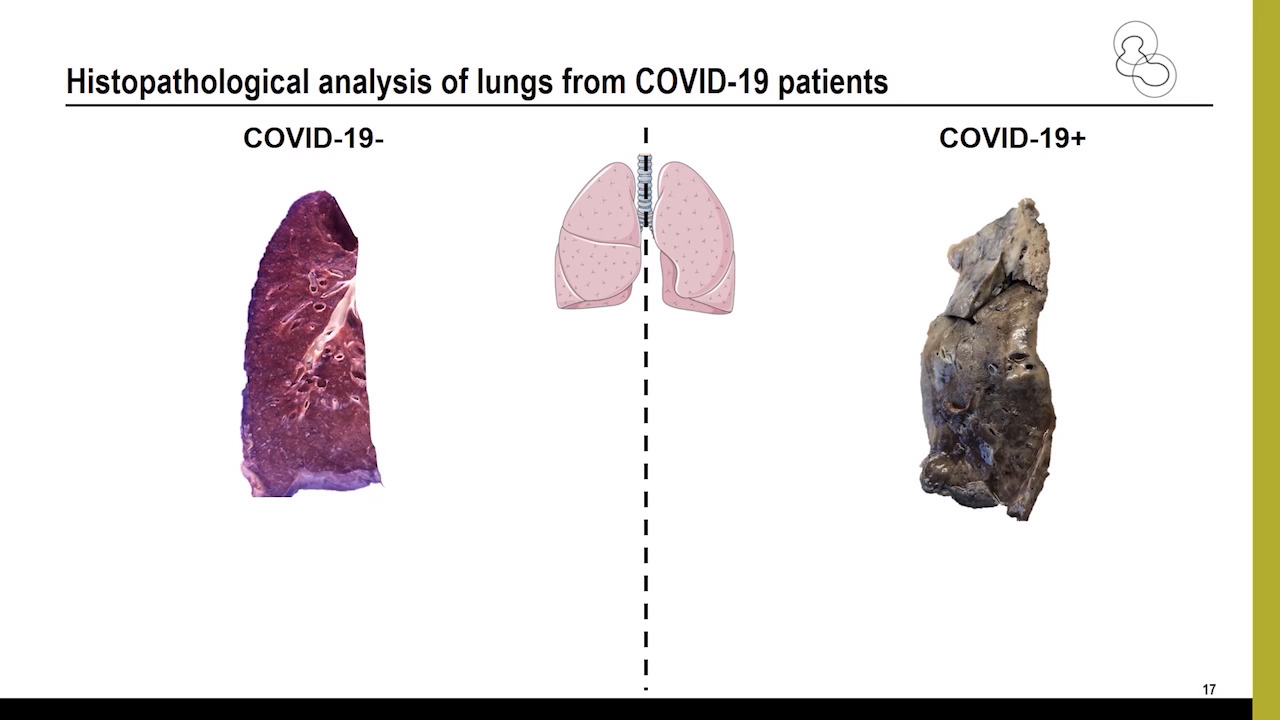
Coronavirus disease 2019 (COVID-19) is a new pandemic disease caused by infection with severe acute respiratory syndrome coronavirus 2 (SARS-CoV-2). A multi-institutional exploratory research taskforce, named EXPLORE COVID-19, conducted a longitudinal analysis of immune responses of patients at various stages of COVID-19 severity. The goal of the study, which also included a team from Innate Pharma, was to gain translational insights to better understand the immune response in COVID-19 patients and identify potential targets to fight the viral infection. During this webinar, Dr. Remark will provide an overview of the study methodology. Thereafter, he will focus on the C5a-C5aR1 axis and explain its role in the pathophysiology of acute respiratory distress syndrome. This was done by using several techniques, including multiplexed immunohistochemistry. Together, the data support C5a-C5aR1 axis blockade as a means of limiting myeloid cell infiltration in damaged organs and preventing the excessive lung inflammation and endothelialitis in COVID-19 patients. The results from this study were applied to an ongoing COVID-19 clinical trial.
Related Posts

Accelerate Building Custom Spatial Proteomic Panels for New Biological Insights

Ultrasensitive Neuroimmune Biomarker Measurement for Translational Research and Therapeutic Development

Underdiagnosis of Alzheimer’s disease pathology in patients with cardiovascular disease

Decoding Neurodegeneration: High-plex Spatial Proteomics Reveal Distinct Cell Phenotypes and Pathological Signatures in Parkinson’s and Alzheimer’s Disease
In this webinar, Dr. Birgitt Schuele, Associate Professor (Research) of Pathology at Stanford University, showcases how ultrahigh-plex spatial proteomics is being used to uncover distinct cell phenotypes and pathological signatures…

Understanding the Brain: Advancing Neurodegeneration Research with Ultrahigh-Plex Spatial Proteomics
In this webinar, learn how ultrahigh-plex spatial phenotyping has been applied to neurodegenerative disease research.

p-Tau 205 and p-Tau 212: Emerging Biomarkers for Alzheimer’s Disease Research

Spatial Awareness: AI-powered Profiling of Trillions of Immune Cell Distribution Data Points Reveals Key Predictors of Cancer Recurrence Risk
This webinar highlights a groundbreaking study recently published as a Nature cover story (April 2025). Dr. Joe Yeong will describe how a pre-designed analytical framework—driven by well-defined clinical and scientific…

Multimodal Single-Cell Spatial Transcriptomics and Proteomics to Uncover the Biological Processes Driving Immunotherapy Response and Resistance in Renal Cancer
In this webinar, Dr. Anne-Laure Cattin from the Cancer Dynamics Laboratory at The Francis Crick Institute in London, will share her research on kidney cancer, focusing on the integration of…